Garage door opener repair in Austin, from a hum to a dead board
The opener is the one part of the door most people think of as the door, and it's the part that Austin summers and Austin storms are hardest on. Gears strip in the heat, boards die in the first thunderstorm, and remotes stop talking to a unit that's still perfectly good. Most of it is fixable in one visit; some of it isn't worth fixing, and we'll say which.
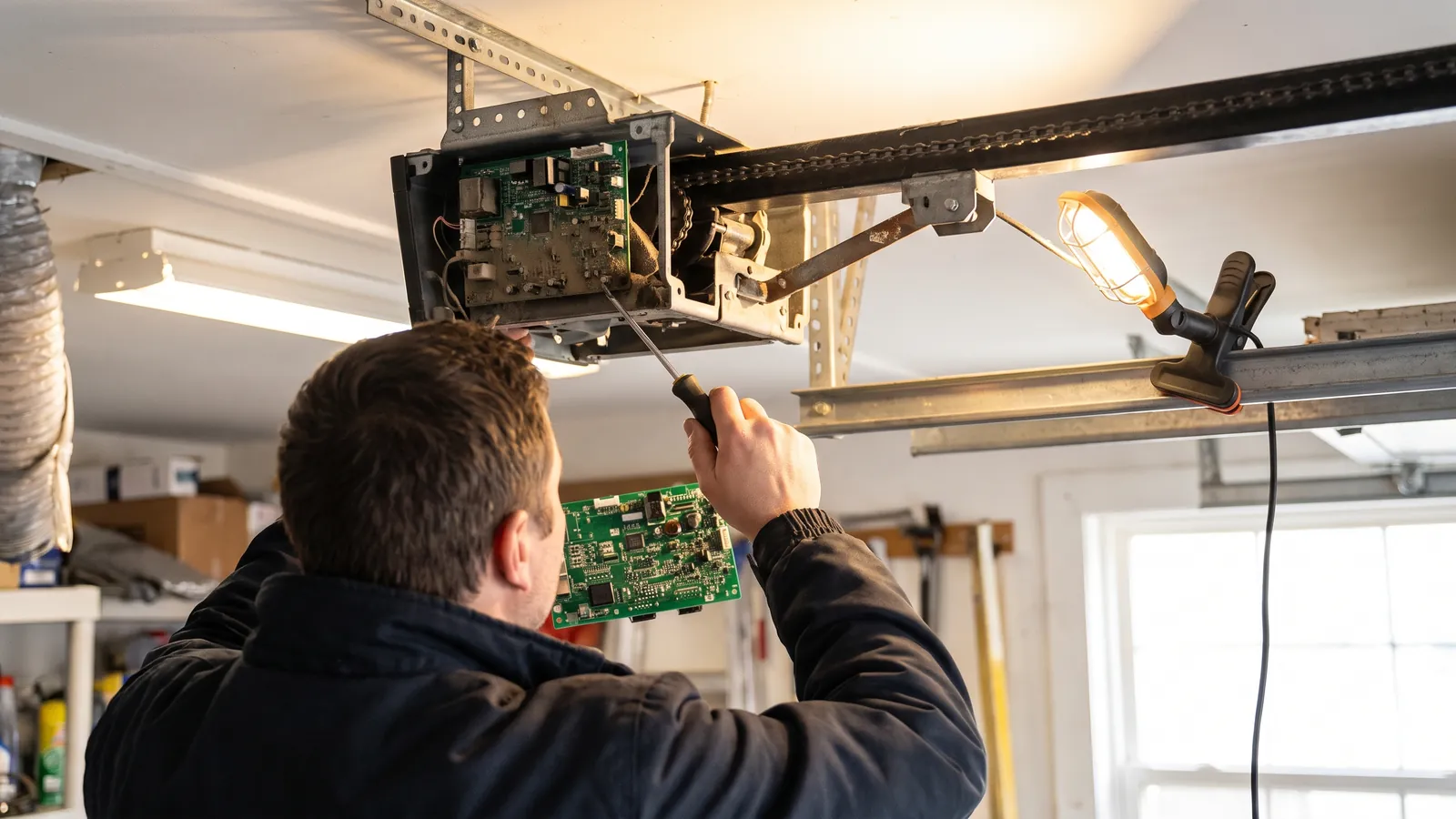
Start with what the opener is doing, because each symptom points somewhere specific. A motor that runs or hums while the door stays down has usually stripped the teeth off its nylon drive gear, the single most common opener failure in this metro, or its trolley has been disengaged, or a spring has broken and the motor can't lift the door alone. A unit that clicks, buzzes briefly and stops has a capacitor that can no longer kick the motor over. A door that stops partway or reverses on its own has drifted travel limits, force settings that are too low for a door that has lost its balance, or photo-eyes out of line. Lights that flash a code are the opener telling you which of those it is, if you know the brand's code list. And a unit that is dark after a storm has had its logic board taken out by a surge down the power line, which in Travis, Williamson and Hays counties happens every time a line of thunderstorms crosses I-35.
The heat is the other half of the story. A garage under a west-facing roof holds 110 degrees and more through July and August. Opener gearboxes are packed with grease that is rated for far less than that, so it thins and runs out of the housing, the nylon drive gear runs dry and strips, and the motor runs on with nothing to push. Chain and belt drives both suffer it; belt drives a little less because the belt doesn't need the sprocket the chain does. Limestone dust, which sits in the air around every construction site from Georgetown to Buda, settles on the rail and in the trolley and turns whatever lubricant is there into paste. A gear and sprocket kit, a capacitor, a trolley, a rail clean and relube, or a travel-and-force reset puts most of these units right, and those parts ride on the truck for the common LiftMaster, Chamberlain and Genie models.
Boards are the judgment call. A logic board is a fraction of the price of a new opener and a straightforward swap on a unit less than ten or twelve years old. On an older unit, especially one without photo-eyes, with a worn chain and a motor that was already tired, putting a new board into it is money that could have gone toward a new opener with battery backup, a soft-start motor and a phone app. The technician gives you both prices and a plain opinion on which is the better spend; the rule of thumb is that a repair over about half the cost of a new unit on an opener past twelve years is a repair we'd talk you out of.
Remotes and keypads are the quick ones. A remote that works at the wall but not from the car is nearly always a battery or a lost code, and a keypad that has gone deaf usually wants a battery and a reprogram. A unit that has been accidentally put into vacation or lock mode from the wall console answers to nothing until it's turned off. We check those before anything is taken apart. Austin Garage Door Tech isn't affiliated with any opener manufacturer; the brand names here describe what gets repaired.
What the visit covers
Symptom to cause in minutes
Hum, click, partial travel, blinking code or silence: each one is run down to its part before anything is replaced.
Gears, capacitors and trolleys on the truck
The kits that fix most LiftMaster, Chamberlain and Genie units are stocked, so the common repair finishes in one visit.
Boards with a second opinion
A surge-killed board is replaced when the unit is worth it, and priced against a new opener when it isn't.
Limits and force set properly
Travel and force settings are reset against a balanced door, then the two-by-four reverse test proves the safety system works.
Remotes, keypads and lock mode
Batteries, codes and the wall-console lock switch are checked first, because they're the cause more often than people expect.
The door checked too
An opener that's straining is often lifting a door with a tired spring, and that gets found and quoted rather than hidden behind a new gear.
Opener repair cost in Austin, TX
| Work | 2026 range | What moves it |
|---|---|---|
| Drive gear and sprocket kit | $160 – $280 | The most common fix |
| Capacitor | $120 – $200 | Click-and-stop units |
| Logic board | $190 – $360 | Depends on model and age |
| Trolley or carriage | $140 – $240 | Disengaged or cracked |
| Travel, force and photo-eye reset | $85 – $150 | Often enough on its own |
| Remote or keypad reprogrammed | $60 – $110 | Plus the remote if a new one is needed |
| Chain or belt replaced | $150 – $290 | Stretched or frayed |
| Trip and diagnosis | $85 – $135 | Credited against the repair |
Austin-area figures for 2026, there to help you budget rather than to stand as a quote. The technician measures your door and names the number before any work begins, parts and labour on separate lines; a new door or opener comes with a written price that holds for 30 days.
On the job
Questions about opener repair
The opener runs but the door doesn't move. Is the motor dead?
Almost never. The motor is running; what's gone is the nylon drive gear that connects it to the chain or belt, or the trolley has been disengaged, or a spring has broken and the motor can't lift the door alone. All three are checked in the first few minutes.
Is it worth fixing a 15-year-old opener?
Sometimes, for a capacitor or a gear. For a board or a motor on a unit that old, usually not, because the next part is coming and a new opener brings battery backup and proper safety sensors. We quote both and tell you which we'd choose.
My remote works right next to the opener but not from the driveway.
The antenna wire hanging from the unit may be broken or tucked up, the remote battery may be weak, or there's interference from a new LED bulb in the opener. All quick to check.
Nothing works, not even the wall button.
Check the outlet with a lamp and the breaker first. If there's power and the unit is still dark, the board has likely gone, often after a storm, and the technician confirms it on site.
Why does it reverse before it reaches the floor?
Either the photo-eyes are out of line or something is in front of one, or the down-force is set too low for a door that has become heavy. We align the eyes, check the door's balance and reset the force in that order.
Can you fit a battery backup to my existing opener?
On some newer models, yes, as an add-on. On most older units it isn't an option, and if outages are the worry a new opener with backup built in is the clean answer.