What a new garage door opener costs installed in Austin, by type
A belt-drive opener installed runs $650 to $1,050 in the Austin area in 2026, with battery backup and Wi-Fi at the top end. Chain drives come in a little under, wall-mount units a little over. Here is what each type costs, what the features actually do, and when a repair beats a replacement.
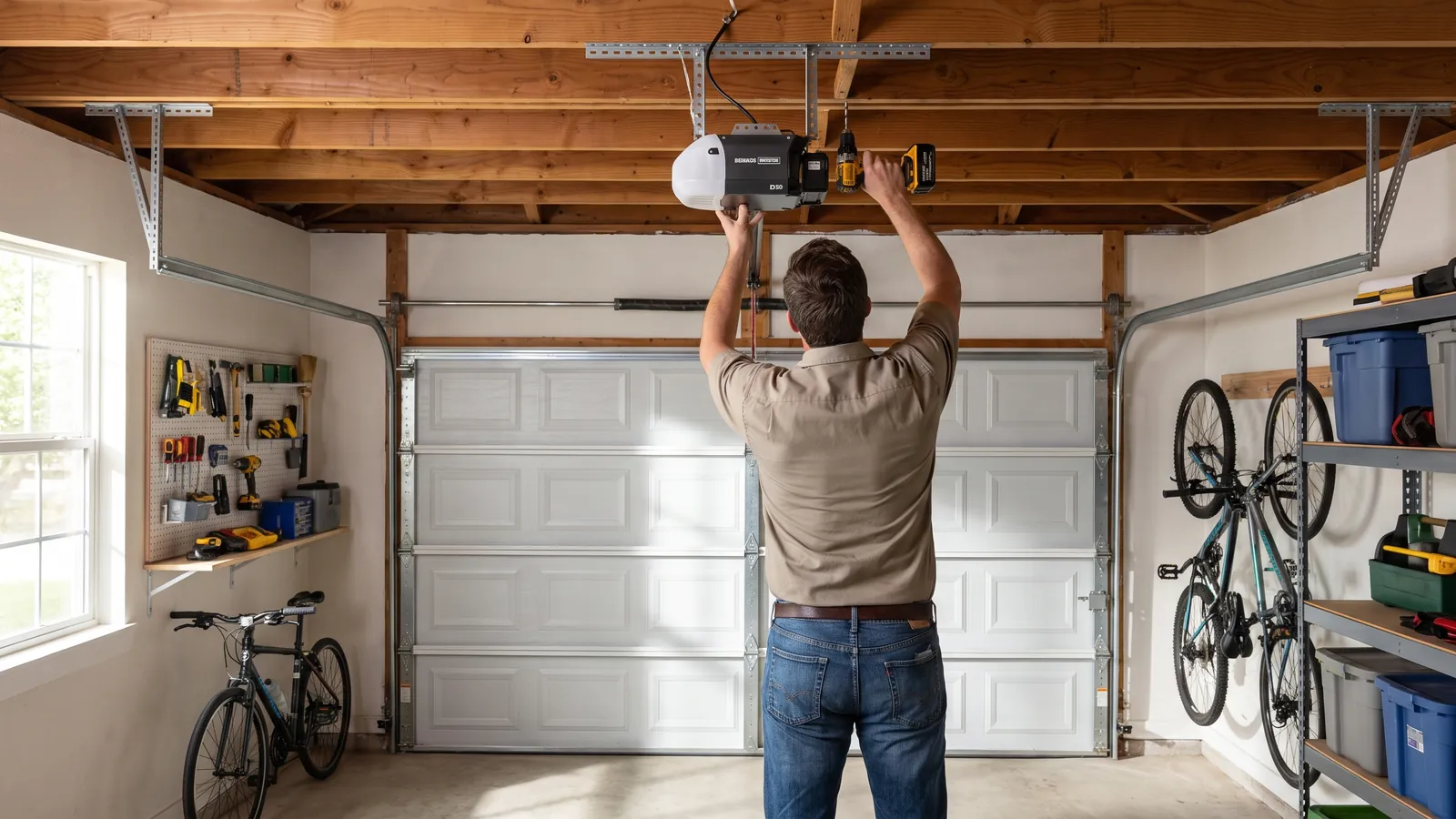
An opener is the one part of a garage door that has a motor, a circuit board and a radio in it, which makes it the part that storms kill, heat ages and manufacturers update every few years. Replacing one is a two-hour job and the price depends on which type you pick and which features you want on it.
By type, installed
| Opener type | Installed | Who it suits |
|---|---|---|
| Chain drive, ½ HP, no backup | $450 – $700 | Detached garage, no bedroom nearby, budget replacement |
| Belt drive, ¾ HP equivalent | $650 – $900 | Attached garage, room above or beside, most Austin homes |
| Belt drive with battery backup and Wi-Fi | $750 – $1,050 | Anyone who has been stuck outside in an outage |
| Wall-mount (jackshaft) with backup | $900 – $1,400 | Low headroom, cathedral ceiling, overhead storage, quietest option |
| Commercial trolley or jackshaft operator | $1,200 – $2,800 | Shops and warehouses; see the commercial page |
What the features do
Belt against chain
Both lift the same door. The belt is a steel-reinforced rubber strap that runs quietly; the chain rattles. In a detached garage nobody cares. Under a bedroom, the belt is the difference between the baby sleeping and not. The price gap is $100 to $200.
Battery backup
A sealed battery in the head unit that gives you twenty to fifty cycles when the power is out. Central Texas loses power in ice storms and in summer thunderstorms, and a door that won't open with a car inside is a bad morning. The battery lasts three to five years and is a $60 to $100 part when it goes. Worth it.
Wi-Fi and the phone app
Lets you open and close from anywhere, see whether the door is open, and get an alert if it's been open for an hour. Built into most mid-range units now; the add-on hub for older openers costs about $60 to $120 installed.
Horsepower
Residential openers are sold as ½, ¾ and 1¼ HP or their "equivalent" for DC motors. A ½ HP unit lifts any balanced residential door; a ¾ handles a heavy insulated double with margin and runs cooler, which matters in a 115-degree garage. The opener should never be doing the lifting; if it has to strain, the springs are the problem.
What's included in the install price
- The opener, rail, trolley and mounting hardware, the wall console and two remotes. A keypad is often included; ask.
- Two photo-eye safety sensors mounted no higher than six inches off the floor and aligned. Every opener sold since 1993 requires them and no technician should leave without them working.
- Force and travel limits set to the door, and the reverse test with a two-by-four on the floor.
- Removal of the old opener and the brackets it left behind.
- Programming of remotes, the keypad, the car's built-in buttons if it has them, and the app.
The outlet question
An opener plugs into a grounded outlet on the ceiling near the head unit. Most Austin garages built since the 1980s have one. If yours doesn't, or the only outlet is on a wall across the garage, you need a new hard-wired outlet, and that is electrical work for a licensed electrician, not the garage door technician. A technician who offers to run a cord across the ceiling or splice into a light fixture is offering you a fire-code problem. Budget $150 to $350 for an electrician if a new outlet is needed, and have it done before the install date.
The licence question
Texas has no garage door licence. The Department of Public Safety licenses alarm and access-control installers, and its guidance says an installer who fits only a garage door opener, with its remotes and keypad, needs no DPS licence unless the opener is tied into an alarm system or records who comes and goes. A standard residential opener with a phone app is neither. Ask about insurance instead.
Repair or replace?
A board, gear kit or capacitor at $160 to $360 makes sense on an opener under about twelve years old that has safety sensors and parts still in production. Past that, or on any opener without photo-eyes, the money is better spent on a new unit. The technician will quote both. See opener not working for the checks to make before you call.
Questions this guide gets asked
How long does an opener install take?
Two to three hours for a straightforward swap, longer if the old rail has to come down from odd brackets or the sensors need new wire run along the track.
Can a new opener fix a door that's hard to lift?
No, and a technician who sells you one for that reason is selling you the wrong part. A hard-to-lift door has a spring problem. The opener is only meant to move a balanced door; fix the balance first.
Will my car's built-in buttons work with a new opener?
Almost always, after programming. Some older cars need a bridge module for the newest rolling-code openers; the technician checks before leaving.
Is a wall-mount opener worth the extra cost?
If you have a cathedral ceiling, low headroom, or want the ceiling free for storage racks, yes. It mounts beside the door on the torsion shaft, runs very quietly, and keeps the ceiling clear. It needs a torsion-spring door and a few inches of side room.
Do I need the technician to come back when the backup battery dies?
No. The battery is a slide-in part most people can change in five minutes; the opener beeps or shows a light when it's time. It's $60 to $100.
Keep reading: Opener installation · Opener not working · New door installation cost